|

Hydroponics:
A Farming Option for Uruguay
Author:
Ing. Agr. (M.Sc) Martín Caldeyro Stajano
Hydroponic farmer (Establishment AQUA FOOD)
International Consultant in Hidroponics and Social Projects
President of the Hydroponic Uruguayan Association (Asociación Uruguaya
de Hidroponia, ASUDHI)
Article published in Almanaque Year 2000 – Banco de Seguros del Estado
del Uruguay. Edition 75.000
copies)
INDEX
1.
INTRODUCTION
1.1
What is Hydroponics ?
1.2
Why has not been used in Uruguay till now ?
1.3 Hydroponic Production Advantages.
2.
HYDROPONIC
POSSIBILITIES IN URUGUAY
2.1
Rural level.
a. Small Rural Farmers (small areas or farms “minifundios”).
b.
Eroded
soils.
c.
Soils
affected by diseases which are of difficult eradication.
d. Commercial crops.
e.
Hydroponic
Fodder.
2.2
Urban level
.
2.2.1
Urban Agriculture.
2.2.2
Social Projects.
a. Physical and Mental Disabled
Persons
b.
Third
Age.
c.
Low
Income Population.
d.
Educational
Centers.
e. Rehabilitation
of people with social insertion problems.
3.
FUTURE PERSPECTIVES
-------------------
1.
INTRODUCTION.
1.1.
What is Hydroponics ?
Hydroponics
is a technology that permit to produce vegetables without soil, in water
or in inert substratum (1), which only supports the roots. The nutrients
for the plants development is given by mineral salts dissolved in the
water, which is called Nutritive Solution (2) and is applied together
with the watering. It allows to grow an ample variety of fruits and
vegetables, for instance: lettuce, tomatoes, carrots, celery,
aubergines, turnips, leeks, strawberries, melons, flowers, etc.
It
is important to point out that the fruits or vegetables grown with
Hydroponic techniques have an excellent taste, quality, high biological
and nutritional value. Besides, the cultivation can be done, nearly
without agro-toxics.
1.2
Why has not been used in Uruguay before now ?
What
sense would it have in a country like Uruguay, with ample fertile soils,
-that in their major part are unexploited or under exploited- with
abundant potable water, try to use Hydroponics ?
In
our country, up to now, Hydroponics has been considered as a technology
that:
 is specifically only
apt in regions where there is no soil or water, is specifically only
apt in regions where there is no soil or water,
excess of cold or heat, that inhibits the vegetal to grow
and for
these reasons Hydroponics may be effective
it is highly practiced in developed countries, such as Japan,
United States or Holland;
it is very expensive, but with great benefits;
it is complex and sophisticated, not for us.
For all these reasons, its use in Uruguay has been up to now
unthinkable. It is not studied at Superior Educational Centers, neither
included in specific agro-research in the country.
1.3 Hydroponic Production Advantages.
What
follows is a synthesis of a series of advantages:
the plant finds the best conditions to grow,
sowing times become closer,
no weeds existence,
for these reasons, the use of agro-toxics is reduced or
eliminated,
high yields,
product stands out.
2.
HYDROPONIC
POSSIBILITIES IN URUGUAY.
Hydroponics
has excellent uses in rural areas and also in urban zones. There is a
complete lack of information and/or experience on this subject. For this
reason some potential uses to be developed in the country are hereby
presented.
2.1 Rural level.
a) Small
rural farmers (minifundios) : This technology allows to get high
yields in reduced areas. It is perfectly adequate for the limited space
of the small farmer.
b) Eroded soils. Hydroponics
does not require soil, only space is needed; therefore it would allow
that some eroded zones of the country could
produce vegetables again.
c) Soils with diseases of difficult
eradication. There are already areas in the country affected by
soil diseases, especially at greenhouses. The use of soil disinfectants,
such as Methyl Bromide is required (its use is forbidden in Europe since
the year 2000 and in Uruguay at 2005). Hydroponics does not require the
use of these agro-toxics, since there is no diseases at the root level.
d) Commercial
crops.
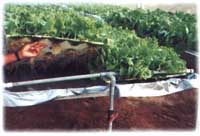 Commercial
crops as lettuce, and flowers are already being developed in
greenhouses, for its excellent quality. It can also be adapted to
ornamental nurseries, forests, etc. Commercial
crops as lettuce, and flowers are already being developed in
greenhouses, for its excellent quality. It can also be adapted to
ornamental nurseries, forests, etc.
e) Hydroponic
Fodder.
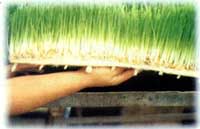 The
production of hydroponic forage provides food for dairy and meat cattle,
horses, etc. This forage is of the highest quality and nutritional
value. The
production of hydroponic forage provides food for dairy and meat cattle,
horses, etc. This forage is of the highest quality and nutritional
value.
2.2 Urban Level.
This is the most innovative aspect
and fundamental characteristic of Urban
Agriculture.
2.2.1)
Urban Agriculture.
Hydroponics
is ideal for vegetable production in urban and peri-urban areas; it is
an answer to the urbanization and modernization process, as long as it
means a return to nature.
Hydroponics allows the use
of spaces, that up to now has not been profitable, because it does not
require any soil, just a space that receives sunlight. Besides,
knowledge has been acquired in order to plant in reduced spaces, such at family level, in: terraces, balconies, windows, walls, roofs.
Urban Agriculture, among
others, has the following benefits:
to consume vegetables with
real taste, without agro-toxics, etc.
to increase vegetables
consumption, and therefore improving
diets,
to consume fresh and natural
products,
to reduce the cost of the
family diet,
to promote a family income,
it gathers the family on the
same activity,
it contributes to get closer
to nature.
it makes the cities more
beautiful, when balconies, roofs, yards
and gardens are full of plants and flowers.
2.2.2) Social Projects :
a) Physically and mentally
disabled persons.
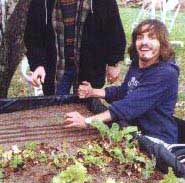 This technology can be a
brilliant solution to limitations of this population. For instance, someone
in a wheelchair can cultivate plants that grow at a table level, with no
problem at all. This technology can be a
brilliant solution to limitations of this population. For instance, someone
in a wheelchair can cultivate plants that grow at a table level, with no
problem at all.
It has also other advantages, such as stimulating their approach to
nature, to feel useful and more integrated to the community and even to
be able to receive an income. We have started an experience in
Montevideo.
b)Third Age.
This technique is also valid
for this population, when they are unable to make great efforts, or
bending down. Hydroponics at a table level is ideal, with identical
advantages as in the previous case.
c) Low
income population.
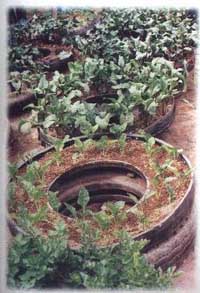 There is a low cost
technological package for Urban Hydroponics,
for low income population, which has been developed in Colombia.
This technological package was taken by FAO, in order to diffuse it
in the rest of Latin America, as a strategy to overcome poverty.
By this means, families can produce their fruits and vegetables, at a
very low cost and in a very simple way. Leftover or recycled materials
can be used for this production, that is ideal for these populations. There is a low cost
technological package for Urban Hydroponics,
for low income population, which has been developed in Colombia.
This technological package was taken by FAO, in order to diffuse it
in the rest of Latin America, as a strategy to overcome poverty.
By this means, families can produce their fruits and vegetables, at a
very low cost and in a very simple way. Leftover or recycled materials
can be used for this production, that is ideal for these populations.
Hydroponics crops, may promote income to
contribute to the family economy, allowing them to commercialize
what they do not need for their own consumption. There are already some
examples in Uruguay.
d) Educational Centers.
It is
shocking to see a lettuce growing in the water. This awakens the
curiosity to children and adults too; and leads to reasoning. For this
reason in some countries,
Hydroponics is used to stimulate populations in school and high school.
Some experiences have started in our country, at kindergarten, schools
and high schools.
e) Recuperation of populations
with social insertion problems.
There are many
other uses for Hydroponics, due to its renovating effect that allows to
increase self-esteem and to be nearer to nature. It is being used in
other countries with populations of drug addicts, prisoners, etc.
¿ Why
Hydroponics has not been developed before in Uruguay ?
In
first place, because exists a strongly rooted concept in Uruguay,
“ land and water are abundant and
un-expensive ”. This is a big prejudice against
Hydroponics.
The
second reason, is the lack of information, these techniques and benefits
had been totally unknown in the country. We are promoting pilot
experiences in the fields above mentioned.
The
third aspect was the unavailability of the hydroponic technology and
experience (nutritive solution and other aspects) in Uruguay. Today
exists.
3.
FUTURE PERSPECTIVES.
Hydroponics
is already working in Uruguay. There are farmers that use this
technique, there are families that are producing at their homes and
there is several social projects on the way. These experiences will have
a multiplying effect on the common population, with all the advantages
that the technique can offer in production, nutrition, etc.
The
existence of the Asociación Uruguaya de Hidroponia (ASUDHI) (Uruguayan
Hydroponic Association), gathering people interested in Hydroponics,
contributes to the development of the sector.
Countries
of the MERCOSUR (Brasil, Argentina, Paraguay and Chile) cultivate with
Hydroponics since some years ago. They have the advantage of existence
of Research Centers and Universities where Hydroponics is being tested.
It will therefore be vital for the future, that the research
Institutions in Uruguay may contribute to the betterment of the
Hydroponic technology, in order that it may be still better adapted to
the country conditions and so it will also be better applied.
Vocabulary:
(1)
Substratum: the solid condition for the rooting of the plant.
(2)
Nutritive Solution: water with mineral salts added. Ideally it is a
solution that provides all mineral
elements essential for plant
growth.
|